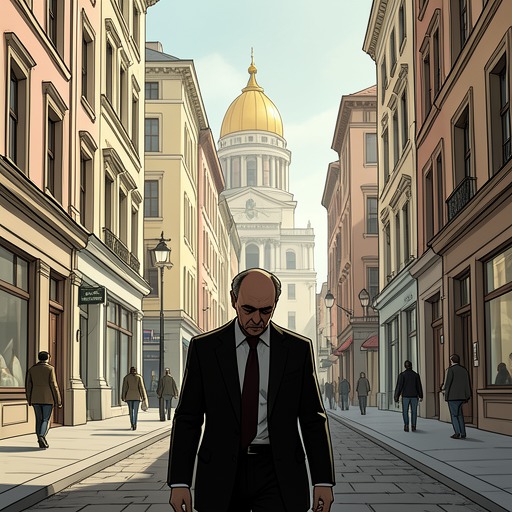
Bérenger’s isolation
The KillerBérenger’s isolation is made explicit as he walks alone toward the Prefecture to pursue The Killer. It is not simple indifference to other people: he says he loves humanity, but at a distance, and presents his mission as an effort to act for mankind and for Dany. The passage makes that distance concrete through the deserted road, his repeated calls for Édouard, and the echo that answers in place of a companion.
Identity and Outlook
Bérenger describes solitude as a long-standing condition, saying, "I've always been alone." He also insists that this does not mean he has ceased to care about others: he is interested in the fate of mankind, though his love for the human race remains at a distance. His isolation therefore coexists with a declared sense of public purpose, but leaves him to pursue that purpose without reliable company.
The Pursuit and Its Companions
Walking toward the Prefecture, Bérenger expects Édouard to catch up and calls his name more than once. When the echo returns only fragments of it, the hoped-for companionship remains absent. He considers turning back to find Édouard and going to the Prefecture together the next day, but rejects the delay: he tells himself to think of Dany and seek revenge, and reasons that he has already come too far. His movement forward is thus sustained by obligation and self-persuasion rather than by another person’s presence.
Institutional Abandonment
Bérenger’s solitude is also political. He complains that the police teach manners but do not care when protection is needed, and says they have let him down. He wants to speak to the Chief Superintendent and reform the police, yet still believes the Civil Service will protect him. That confidence sits uneasily beside his experience of institutional failure: he is left to carry out the pursuit himself, on a road he fears may not be safe and before darkness falls.
The Road as an Image of Isolation
The passage repeatedly makes progress uncertain. Bérenger says the avenue seems endless and that he is not getting nearer, then reassures himself that he is advancing. With the wind rising and the light fading, he scans behind and ahead, calls again for Édouard, and mistakes a leaf from an old newspaper for a possible threat. The echo even repeats his laugh. The scene ends with him setting off cautiously once more, still without confirmation that Édouard is near. His isolation is therefore not merely stated: the emptied street, unanswered calls, and hesitant forward movement give it dramatic form, while his resolve to act for Dany and humanity keeps him moving.